What It Means to Hold Society Together in a Time of Change
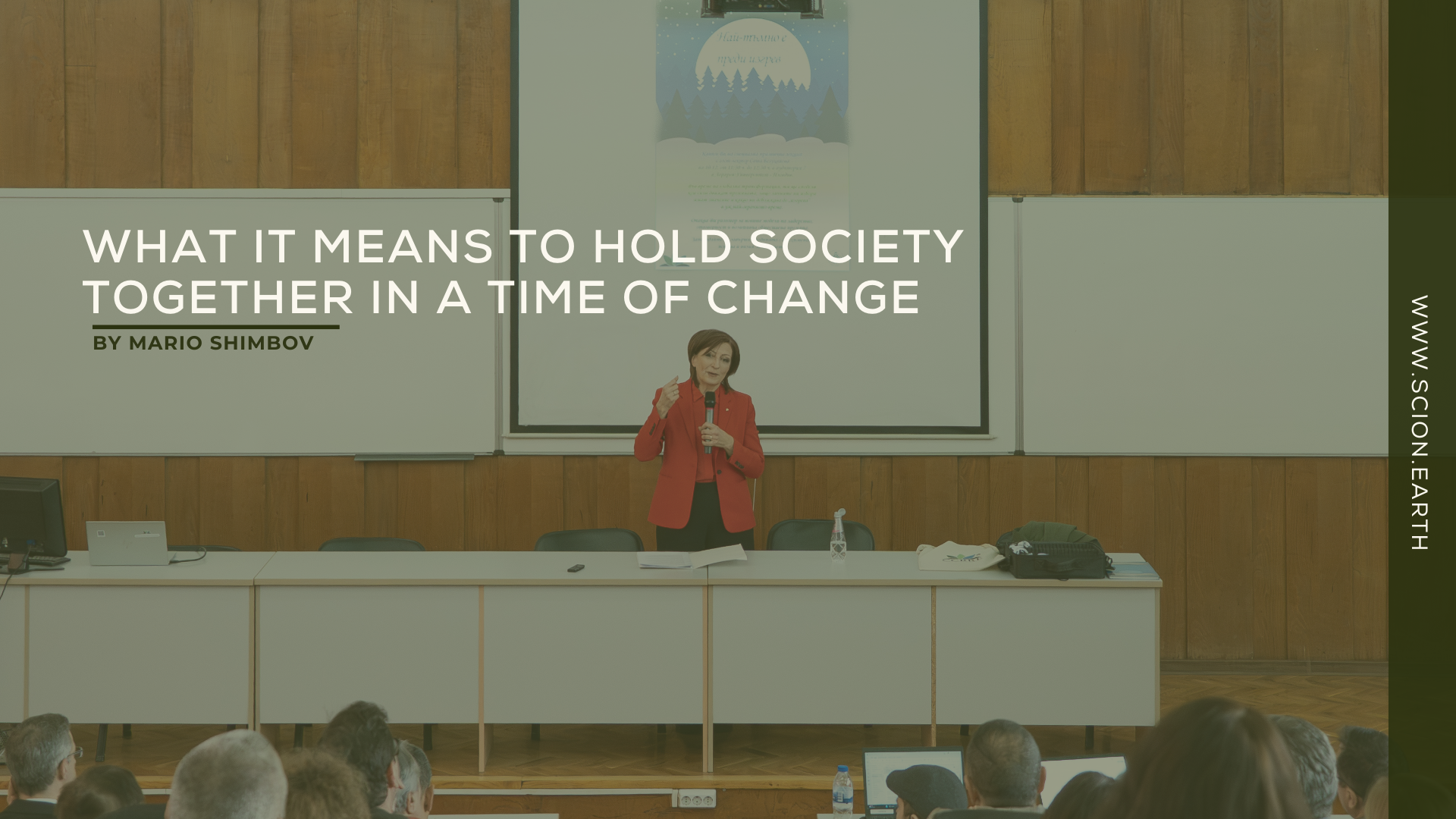
Sasha Bezuhanova, co-founder of SCION, delivered a visionary public lecture titled “After the Darkest Hour Comes the Sunrise” at the Agricultural University of Plovdiv. The event was part of the inaugural Christmas lecture series organised by The Centre for Cleantech and Biomass Resource Efficiency (CCBRE), an independent centre based at the University.
The keynote speaker brought her characteristically clear, steady energy to the room. Known for her work in technology, sustainability, and civic leadership, she spoke not about abstract systems, but about the deeper shifts shaping society today.
A world crossing from one era into another
Sasha described the present moment as a birth process rather than a crisis.
She explained that humanity is not collapsing but transforming, and that the turbulence we experience is a sign of transition rather than decline.
One of her key reflections came from this passage:
“What we are witnessing is a collision between the institutionalised old and an emerging new era trying to justify its place. It is a birth process, and new worlds are born with difficulty.”
She pointed to the fear-driven narratives, misinformation and social fragmentation that define the current public landscape. For many, she acknowledged, the chaos feels like the end of the world. Stating the obvious:
“This is a time of the Renaissance. After the darkest hour comes the inevitable light.”
The new value system is taking shape
Sasha emphasised that the old formula of success built on domination and fear is losing its ground. A different mindset is emerging, one centred on connectedness, contribution and shared responsibility.
She highlighted a generation of 18–20-year-olds now stepping into civic life with clarity, purpose and a natural affinity for nature, digital culture and volunteering. Their presence is not symbolic; it is catalytic. It signals a collective shift in what societies expect of leadership, business and one another.
A conversation that opened a new tradition
The lecture was attended by students, faculty, partners and guests, including Swiss Ambassador Pierre Hagmann, who joined the audience. Brief conversations afterwards allowed ideas to continue circulating across disciplines and generations, but the focus of the day remained firmly on the substance of the message rather than the setting.
CCBRE’s first Christmas lecture marked the beginning of a new tradition grounded in reflection, dialogue and long-term thinking. It offered a reminder that even in periods of uncertainty, there are spaces where people can step back, ask better questions, and orient themselves towards the future with clarity and purpose.
In that sense, the event was less about closure at the end of the year and more about opening a conversation that will continue.